Most building owners and facilities managers focus on the finish, such as the colour, the texture, the chemical resistance, and the slip rating. These are all valid considerations, but the decisions that determine whether a resin floor lasts five years or twenty-five are made earlier in the process, and they are rarely the ones that get discussed in a sales meeting.
Here are five questions worth asking before any contractor starts work. The answers will tell you more about the quality of the installation than the product brochure will.
1. Has the substrate moisture been tested, and with what method?
This is the most important question on the list.
Concrete releases moisture for months after pouring. Ground-floor and basement slabs can have elevated moisture readings for years, depending on site drainage, waterproofing, and seasonal groundwater. A resin flooring system applied over a substrate with moisture content above the primer’s specified tolerance will eventually fail by blistering, delaminating, or lifting as vapour pressure builds beneath the sealed film.
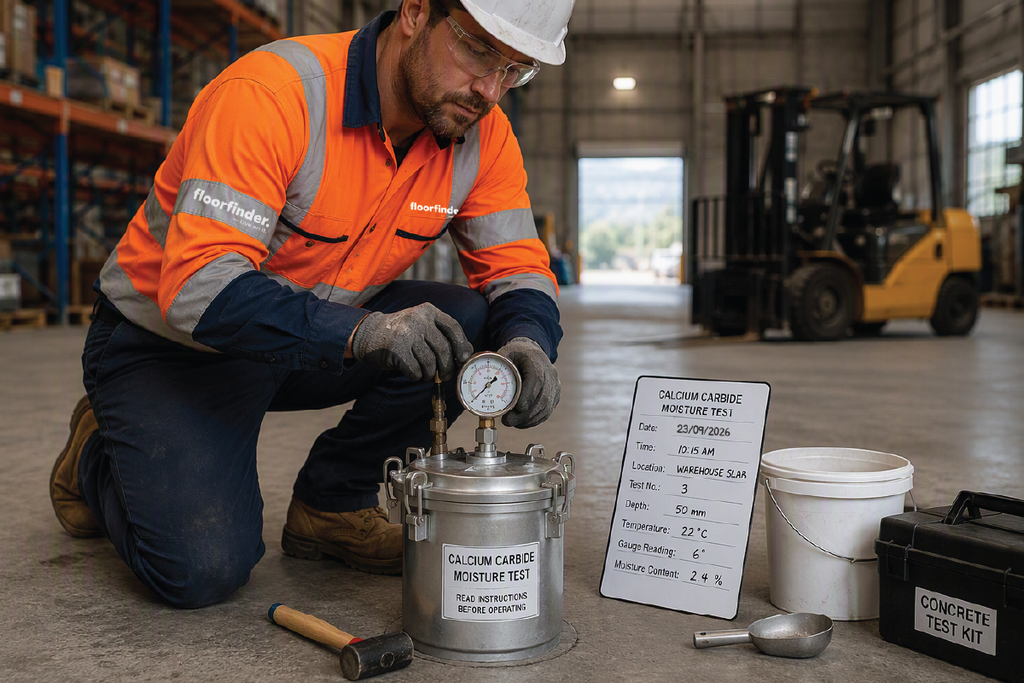
The correct test method is the calcium carbide (CM%) test, which measures moisture content directly from a crushed concrete sample taken from the slab. A substrate reading below 4 CM% is within the tolerance of most standard primers. Between 4 and 6 CM%, apply a two-coat moisture barrier primer. Above 6 CM%, do not apply primer until the substrate has been dried and retested.
If the answer to this question is “we checked visually” or “we used a surface moisture meter,” the substrate has not been tested to the standard required.
2. Has the substrate pull-off strength been verified?
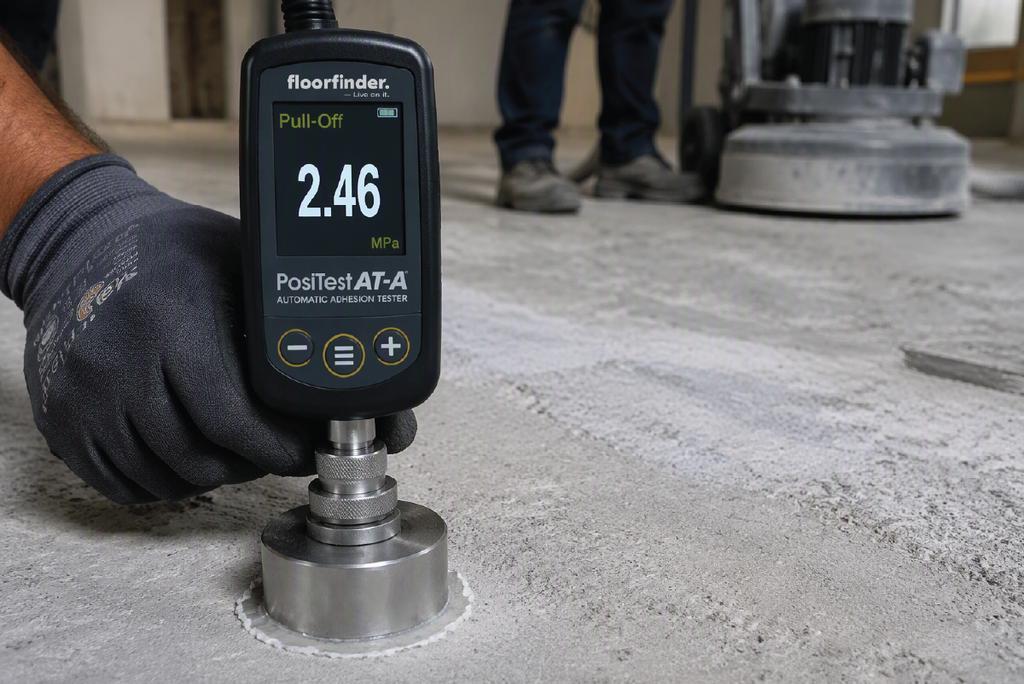
A resin flooring system is only as strong as its bond to the concrete beneath it. That bond is measured by a pull-off test, a standardised method (DIN ISO 4624) that pulls a circular dolly from the prepared surface and records the force required.
The minimum required substrate pull-off strength before primer application is 1.5 N/mm². Below this threshold, the concrete surface itself is too weak to hold the primer, and the entire system above it will eventually separate, regardless of which primer or topcoat is specified.
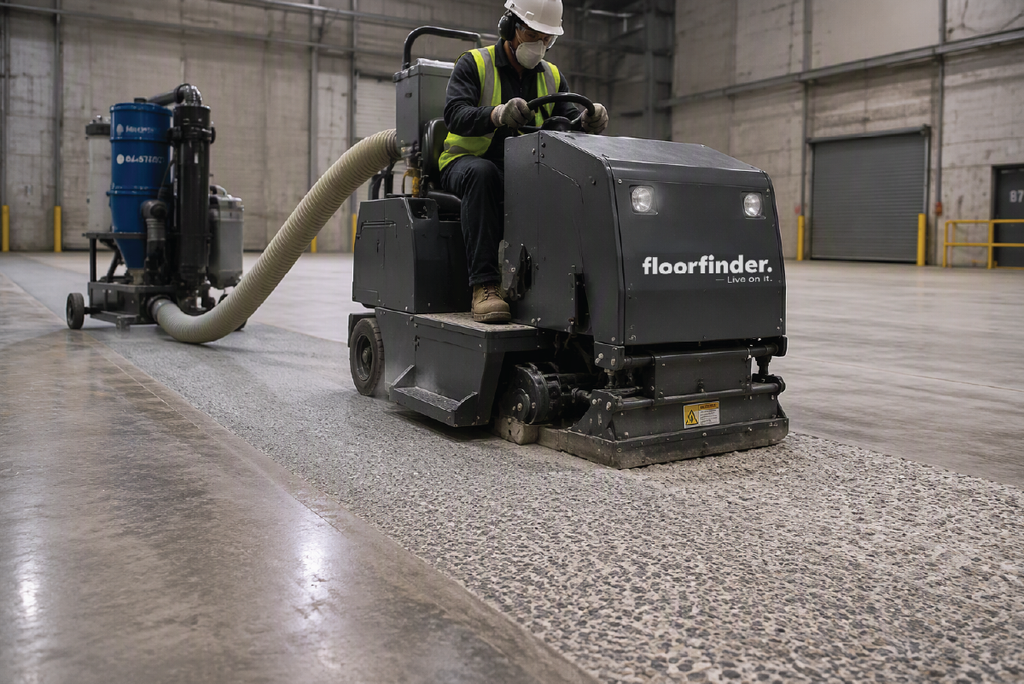
Surface preparation by captive shot blasting or diamond grinding is required to remove laitance, surface contamination, and weak surface layers before priming. Ask to see the preparation method and confirm it was carried out across the full application area, not just in open zones away from walls, columns, and racking bases.
3. Which primer is being used, and why was it selected for this substrate?
This question exposes one of the most common causes of flooring failure.
There are significant differences between epoxy primers. A water-based, low-emission primer suitable for dry mineral substrates is not suitable for a damp concrete slab. A solvent-based rapid primer designed for fast-track commercial programmes has a different moisture tolerance from a prefilled moisture barrier primer. A structural binder-primer rated for heavy industrial loads achieves that performance only when combined with the correct quartz filler, not in the neat primer coat alone.
Ask the contractor to explain the selection: which primer, what moisture tolerance it carries, and why that product is correct for the substrate condition as tested. If the answer is vague, the selection may not have been made on a technical basis.
4. How many primer coats are being applied, and what is the consumption rate?
For substrates with moisture content between 4 and 6 CM%, a single coat of most moisture barrier primers is not sufficient. Two coats are required, applied at minimum specified consumption rates, to produce a closed, film-forming surface that functions as a vapour barrier.
The consumption rate matters because it determines the wet film thickness achieved. Applied too thinly, even a correctly selected primer will not perform its moisture barrier function. Applied in a single coat on a high-moisture slab, the system will be sealed on the surface but will not arrest moisture vapour transmission through the slab.
Ask for the consumption rate per coat and confirm it matches the product data sheet specification for the substrate moisture reading that was measured.
5. What is the overcoating window, and how will it be managed on this programme?
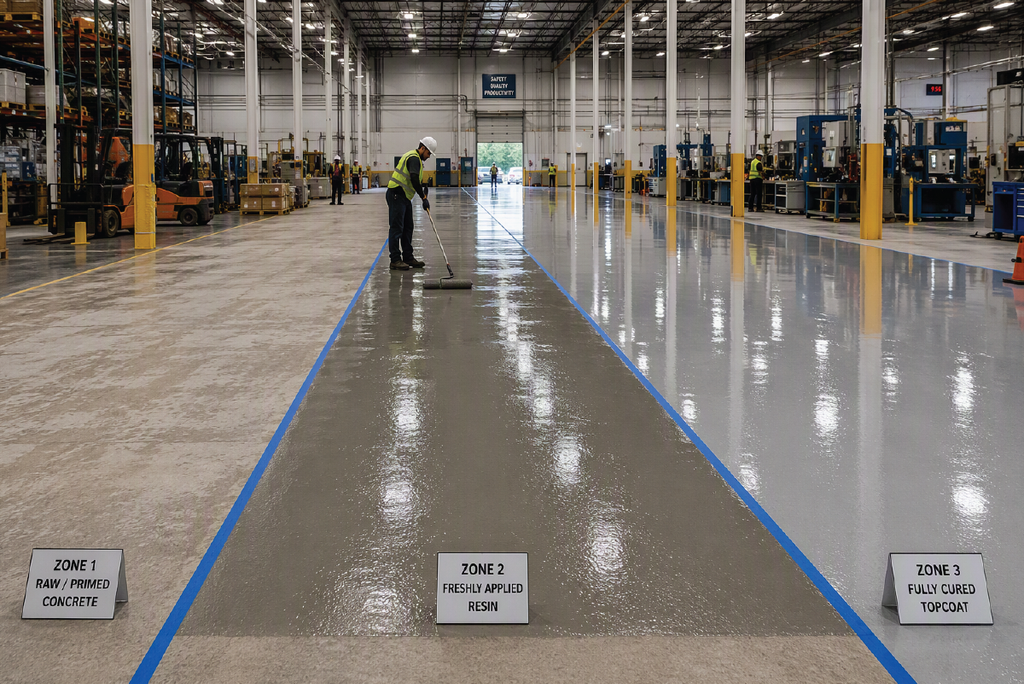
Every primer has a maximum time window within which the following coat must be applied. Miss that window, and the cured primer surface must be mechanically abraded before the next layer can adhere properly. If re-abrasion is not carried out, the system will bond to a surface that is no longer chemically active and will separate at that interface under traffic or thermal cycling.
On phased projects, multi-zone installations, or programmes subject to delay, this window is frequently missed. Ask how the programme is structured to ensure that primer application and overcoating are sequenced within the product’s specified window. Confirm that the contractor knows the specific overcoating window for the primer being used. The window varies between products, ranging from 6 to 36 hours.
Why do these questions matter?
A resin floor that performs for twenty years and a resin floor that requires remediation in two years can look identical at the point of handover. The difference is almost always in decisions made before the first coat was applied:
i)Substrate testing
ii)Surface preparation
iii)Primer selection
iv)Application control
These five questions are not technical challenges. They are due diligence. Any contractor confident in their specification should be able to answer all of them clearly.
Want to learn more about the FLOORFINDER primer range and how each product is selected for different substrate conditions?
Read more articles on our blog.
Contact FLOORFINDER Asia technical team for project-specific primer specification support at https://www.floorfinderasia.com/contact-us/