Unplanned operational shutdowns, premature surface peeling, and endless patch repairs in Malaysian facilities almost always stem from a single misstep during procurement: relying on the word “epoxy” as a catch-all term. While a thin epoxy paint and a heavy-duty self-levelling epoxy may look identical on a quote or a freshly rolled sample, they belong to completely different performance classes.
Choosing a low-bid coating where a structural wear layer is required rapidly leads to surface failure under forklift traffic and tropical humidity. This guide explains the essential technical considerations for thickness, FeRFA classification, TCO and site preparation, to ensure you are specifying the correct system and keeping your budget on target for the long-term.
Defining the Systems
Before reviewing bids, it is important for facility managers to understand that epoxy floor paint and self-levelling epoxy are fundamentally different systems.
What is Epoxy Floor Paint?
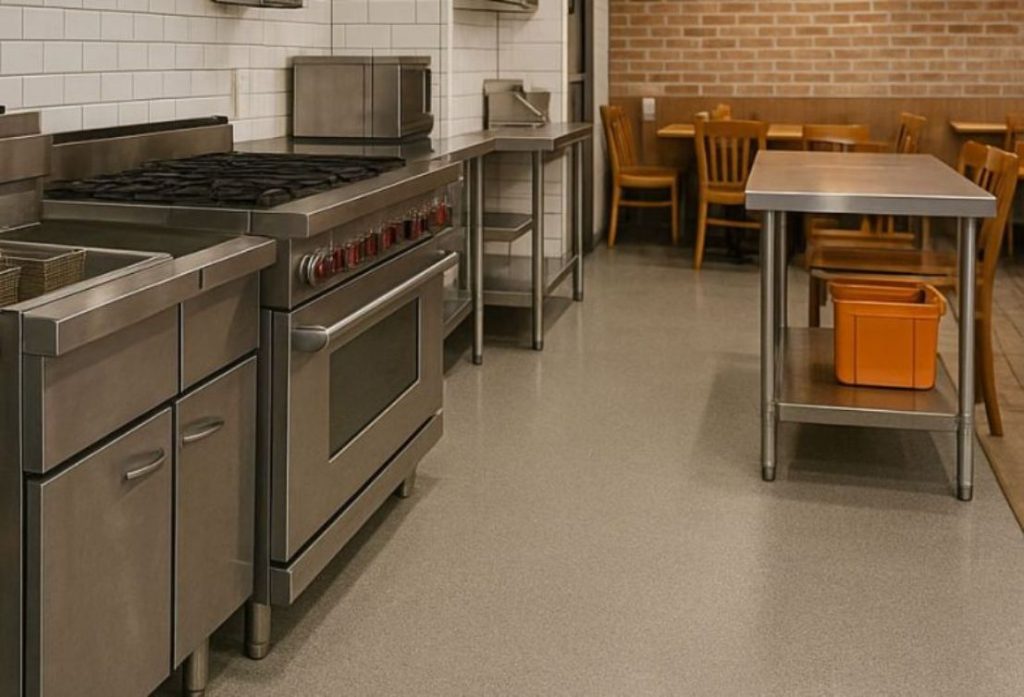
Epoxy floor paint is a thin film paint of less than 0.3 mm (300 microns) dry film thickness that is applied by a roller or spray. It is a mixture of epoxy resin and solvents or water and primarily acts as a dust-proofer, light sealer and temporary cosmetic barrier for light traffic.
What is Self-Levelling Epoxy?
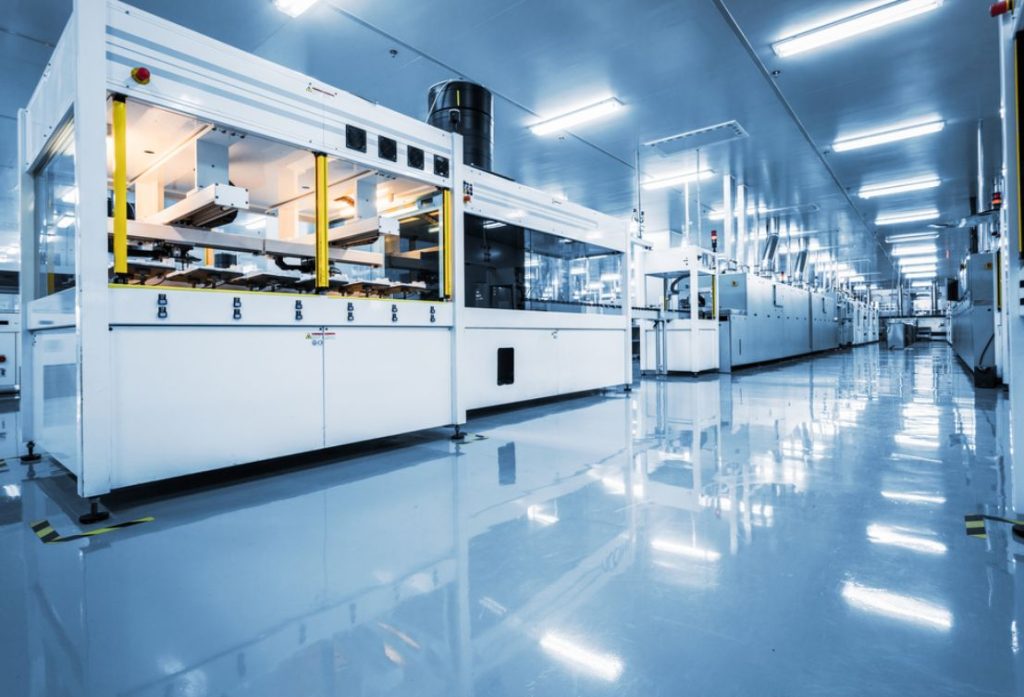
Self-levelling epoxy is a resin-based system that is generally installed at a thickness of 2.0 mm to 3.0 mm, poured and troweled to a smooth, seamless wear surface. It is formulated at or near 100% solids and spreads out on application to form an industrial floor with a high level of strength and resistance to repeated vehicular traffic and mechanical loads.
Epoxy Floor Paint vs. Self-Levelling Epoxy Comparison
Evaluating options requires comparing the functional characteristics of both systems side by side.
| Feature | Epoxy Floor Paint System | Self-Levelling Epoxy System |
|---|---|---|
| FeRFA Classification | Type 1 (Floor Seal) or Type 2 (Floor Coating) | Type 5 (Flow-Applied Flooring) |
| Nominal Cured Thickness | ~0.15 mm to 0.30 mm (150–300 µm) | Typically 2.0 mm to 3.0 mm |
| Traffic Suitability | Light foot traffic, light-duty storage, inspection aisles | Heavy forklift traffic, pallet jacks, heavy machinery |
| Impact & Defect Resistance | Low. Mirrors substrate cracks, divots, and flaws | High. Bridges minor imperfections, resists dropped loads |
| Downtime & Maintenance Profile | High frequency of recoats and spot repairs under medium traffic | Low long-term maintenance; installed as a durable wear layer |
Specs That Actually Dictate Longevity
Understanding key technical parameters helps ensure the chosen industrial flooring solution matches real-world facility traffic.
FeRFA Classifications
The Resin Flooring Association (FeRFA) categorises resin floors from Type 1 to Type 8. Thin epoxy paints generally sit within Type 1 (up to 150 µm) or Type 2 (150–300 µm). Self-levelling epoxy systems typically align with Type 5 (flow-applied, 2–3 mm build). Tenders should explicitly require the FeRFA type or equivalent classification.
Solids Content vs. Real Wear Layer
Volume solids determine how much liquid evaporates as the floor cures. A 100%-solids product retains its wet-applied volume when dry, whereas water- or solvent-based paints (often 40%–60% solids) shrink significantly. High solids alone do not guarantee performance; data sheets must also show adequate abrasion, adhesion, and impact resistance.
Matching System to Operation
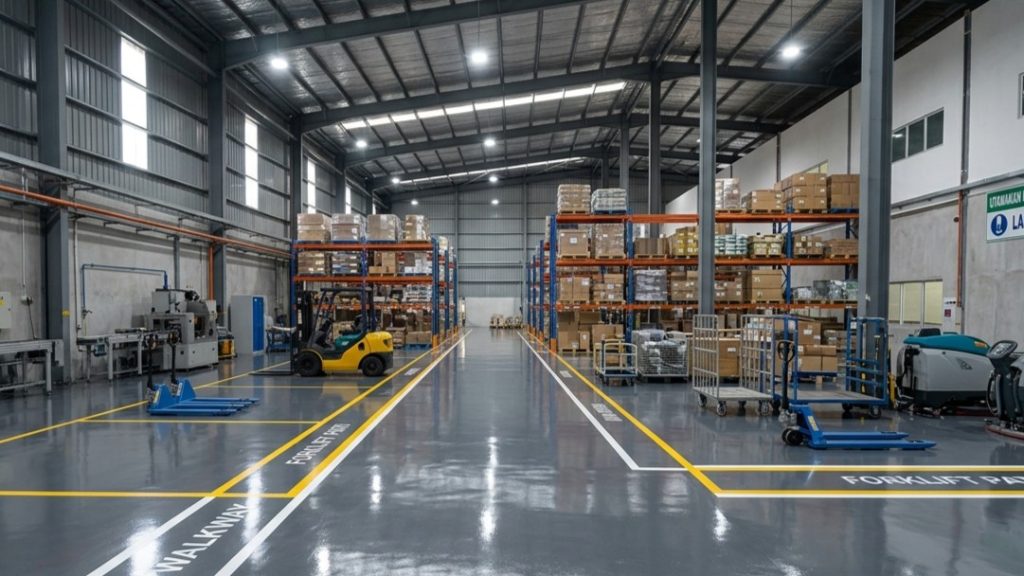
Thin coatings are cost-effective for clean, light-duty zones like electrical rooms, plant rooms, or low-traffic walkways. Heavy production floors, warehouse flooring, distribution centres, and cleanrooms require the structural build of a Type 5 self-levelling system to absorb dynamic loads and point-loading from hard-wheeled forklifts.
UV Exposure Warning
Standard epoxy resins chalk and yellow under ultraviolet light. For loading bays, sunlit doorways, or outdoor areas, an epoxy body coat must be sealed with a UV-stable polyurethane or polyaspartic topcoat.
Total Cost of Ownership (TCO) & Downtime Economics
Judging a floor purely on its upfront supply-and-apply cost per square meter creates a false economy. True longevity depends on site variables including forklift wheel types, traffic frequency, chemical exposure, and cleaning regimes.
Calculating the true cost of a low bid requires evaluating the Total Cost of Ownership:
TCO= Initial Installation + Recoating Costs + Patch Repairs + Surface Preparation + Downtime Losses
When a thin coating fails in a busy logistics or manufacturing facility, the direct cost of repainting is often dwarfed by indirect losses:
- Relocating inventory or machinery away from the work zone.
- Halting production lines or paying overtime to shift schedules.
- Setting up temporary dust containment walls and rental storage.
- Re-clearing and re-preparing the slab for corrective work.
Specifying a higher-build, fit-for-purpose system reduces the frequency of major shutdown windows over the building’s operational lifespan.
Malaysian Climate Realities & Mechanical Prep
Malaysia’s high relative humidity and ambient temperatures present specific risks to resin floor curing and adhesion.
Moisture & Environmental Limits
High concrete slab moisture causes osmotic blistering and delamination. Substrate testing—such as in-situ relative humidity testing (ASTM F2170)—is essential to confirm the slab meets the specific product’s threshold. Where moisture levels exceed specifications, a dedicated moisture-mitigation primer must be applied.
Preventing Amine Blush
Under conditions of high humidity, low temperature, or atmospheric moisture during cure, standard epoxies can develop “amine blush”—a waxy surface residue. If unaddressed, applying a topcoat over a blushed surface leads to inter-coat adhesion failure.
Prep Non-Negotiables
High-performance epoxy systems require mechanical preparation such as diamond grinding or shot blasting to open the concrete pores and remove laitance, curing compounds, and surface contamination. Acid etching or simple power washing should never be accepted as a substitute for mechanical profiling.
Floorfinder’s Self-Smoothing Solutions
When specifying self-levelling flooring systems for heavy manufacturing, cleanrooms, and high-traffic logistics environments, Floorfinder provides target system builds tailored to specific operational exposures.
EP-C500 is a heavy-duty, solvent-free self-levelling epoxy engineered for hygienic environments that demand serious toughness. Once cured, it creates an impervious, seamless surface that resists harsh chemicals, heavy impacts, and frequent washdowns—making it ideal for production plants and cleanrooms. As standard epoxy resins can yellow or chalk when exposed to sunlight, we recommend adding a UV-stable polyurethane or polyaspartic topcoat if installing near sunlit loading bays or windows.
EP-C580 is an advanced, water-based self-levelling floor system built to handle constant forklift and vehicular traffic without breaking down. It delivers a hard-wearing, seamless finish that wipes clean easily and stands up to spilt fuels, oils, solvents, and industrial chemicals. Unlike standard epoxies, its unique formulation provides superior indoor colour stability and weather resistance, making it a reliable choice for high-traffic zones exposed to ambient sunlight.
Consult a Resin Flooring Specialist for the Right Solution
Selecting between an epoxy coating and a self-levelling system, or any other industrial flooring system, comes down to matching your facility’s operational loads, environmental risks, and downtime tolerances against verified technical data.
Have a pending tender or concrete moisture test result you want to verify? Contact our technical team at Floorfinder to submit your project requirements or contractor quotes for an independent specification review.