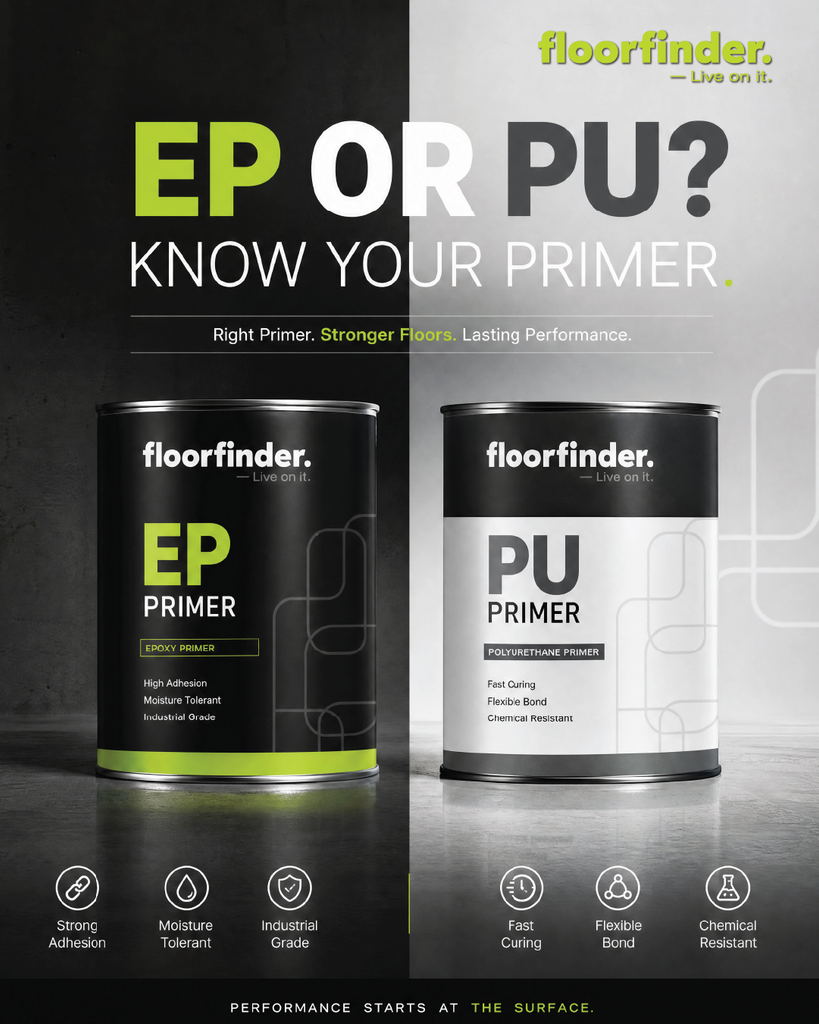
If you have spent any time specifying or installing resin floors, you will have encountered primers labelled Epoxy (EP) and primers labelled polyurethane (PU). In practice, epoxy primers are specified far more frequently, but that does not mean PU primers are a niche afterthought. For certain substrate types and system builds, a PU primer is the only correct answer.
Here is a plain-language explanation of what separates the two chemistries, and how to know which one belongs on your project.
What Is an Epoxy?
EP stands for epoxy. An epoxy primer is a two-component product: a base resin (Component A) and a hardener (Component B) that are mixed together immediately before application. Once mixed, a chemical reaction begins that progressively cures the film. This is what gives epoxy its excellent hardness, adhesion, and chemical resistance.
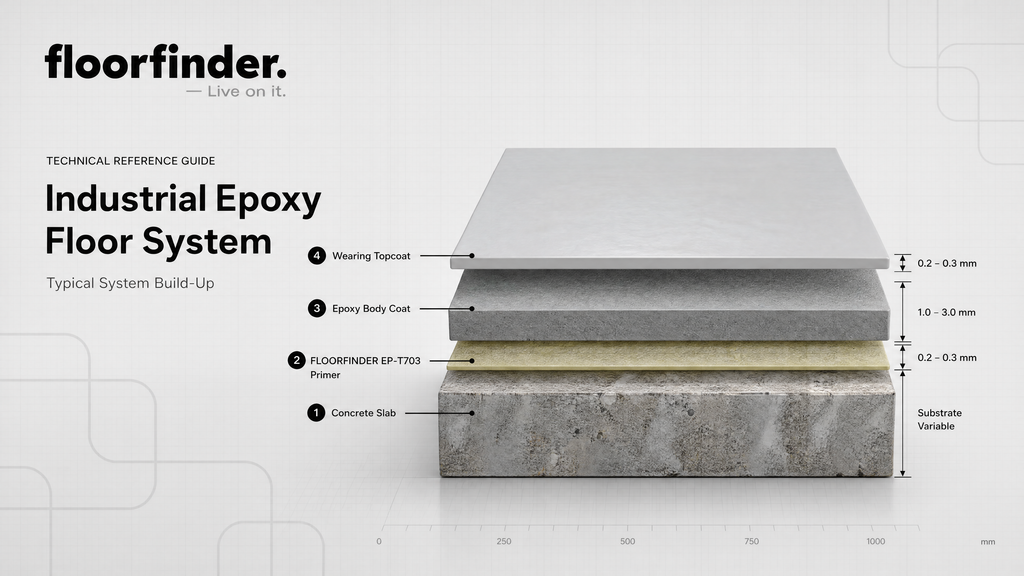
Epoxy primers are the standard specification for concrete and cementitious substrates. They bond strongly to concrete by penetrating the surface pores and forming a mechanical and chemical bond as they cure. Depending on formulation, they can be:
Prefilled
Carrying mineral filler for high film build and moisture barrier capability
Unfilled
Transparent and lower density, used as a penetrating bond coat or structural binder
Water-based
Low-emission and vapour-permeable, for occupied environments and specialist substrates
Solvent-based
Rapid-curing, for fast-track programmes
The FLOORFINDER EP primer range covers all four formulation types across seven products, each addressing a specific combination of substrate moisture, environment, and programme requirement.
What is a polyurethane?
PU stands for polyurethane. Polyurethane chemistry is more flexible than epoxy, both literally, in terms of the elastic properties of the cured film, and in terms of the substrate interfaces it can bond to.
The critical difference is where PU primers are specified. Not on cementitious substrates, since that is the epoxy range’s job, but on non-porous, non-absorbent surfaces where epoxy adhesion is unreliable.
FLOORFINDER manufactures two PU primers.
FLOORFINDER PU-P274 is a one-component, moisture-curing primer for asphalt. It cures not through a hardener but through reaction with atmospheric moisture, which is exactly the chemistry needed to bond to a non-porous bituminous surface. No two-component mixing. No pot life management. But a firm humidity requirement: 40 to 90% relative humidity during application and cure.
FLOORFINDER PU-P2250 is a two-component, solvent-free primer used as a bonding agent between sanded EP or PU membranes and subsequent coating layers. When a cured resin surface needs to receive another coat, particularly on spray-applied waterproofing or existing membrane systems, a standard epoxy primer does not bond reliably to that surface. PU-P2250 bridges that interface.
The Practical Decision
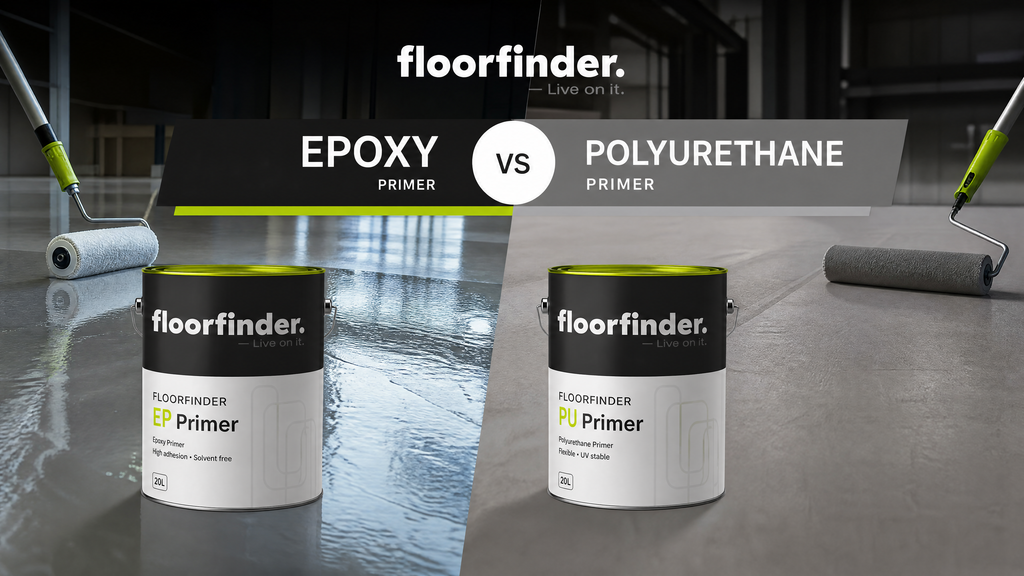
It is a substrate and system question.
Specify an EP primer when:
- The substrate is concrete, cementitious screed, magnesite, anhydrite, masonry, or metal
- The primer needs to manage residual moisture (up to 6 CM% with the correct prefilled EP primer)
- The system build is a standard FLOORFINDER EP or PU flooring system on a prepared concrete slab
Specify a PU primer when:
- The substrate is asphalt (FLOORFINDER PU-P274)
- The primer is being applied onto a cured, sanded EP or PU membrane as an inter-coat bonding agent (FLOORFINDER PU-P2250)
- The next layer is a spray-applied FLOORFINDER coating system that requires a PU-compatible interface
The One Mistake to Avoid
The most common error is treating EP and PU primers as substitutes for each other, but they are not. A PU primer is not a higher-performance version of an EP primer. An EP primer is not a cost-saving alternative to a PU primer. Each chemistry addresses a substrate interface that the other does not reliably handle.
Applying an EP primer to asphalt will not achieve the adhesion that FLOORFINDER PU-P274 achieves. Applying a standard EP primer between two cured resin layers will not achieve the inter-coat bond that FLOORFINDER PU-P2250 achieves. The chemistry must match the interface.
A Simple Reference
| Substrate | Recommended primer chemistry |
| Concrete and cementitious substrates | EP (select product based on moisture reading) |
| Magnesite, anhydrite, masonry | EP-P285 (water-based EP) |
| Metals such as steel, aluminium, galvanised | EP-P285 (water-based EP) |
| Asphalt | PU-P274 (1-component PU) |
| Sanded EP or PU membrane | PU-P2250 (2-component PU) |
| FLOORFINDER spray coating systems | PU-P2250 (2-component PU) |
The Bottom Line
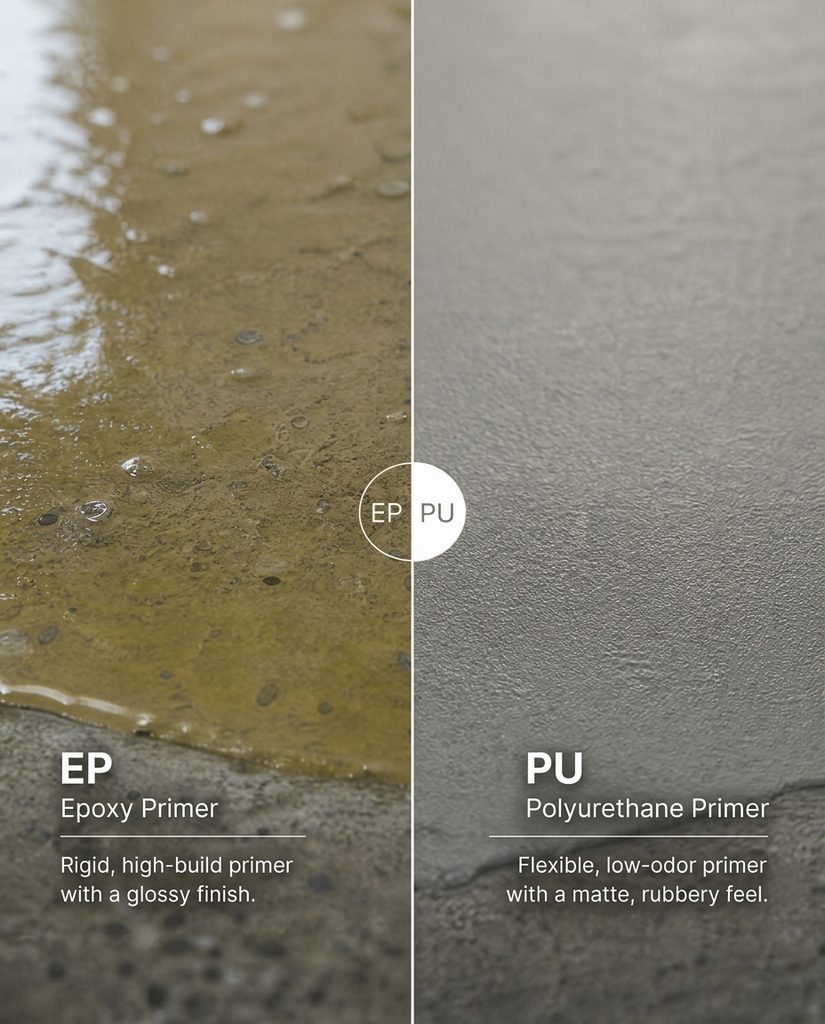
For the vast majority of resin flooring projects on concrete substrates, an EP primer is the correct specification. The FLOORFINDER EP range covers every moisture condition, substrate type, environment, and programme requirement that concrete-based installations present.
PU primers address the interfaces that sit outside that scope, asphalt and cured resin surfaces, and for those substrates, they are not optional.
Knowing which chemistry you need before the project begins is the difference between a specification made on technical grounds and one made by habit.
To understand which specific EP primer is correct for your substrate moisture condition, environment, and programme, read our full selection guide: Selecting the Correct Primer: A Complete Guide to the FLOORFINDER Primer Range.
For the engineering detail behind every product, including density, viscosity, film thickness, and test standards, see our Technical Reference Guide.
Contact the FLOORFINDER technical team at floorfinderasia.com for project-specific advice.